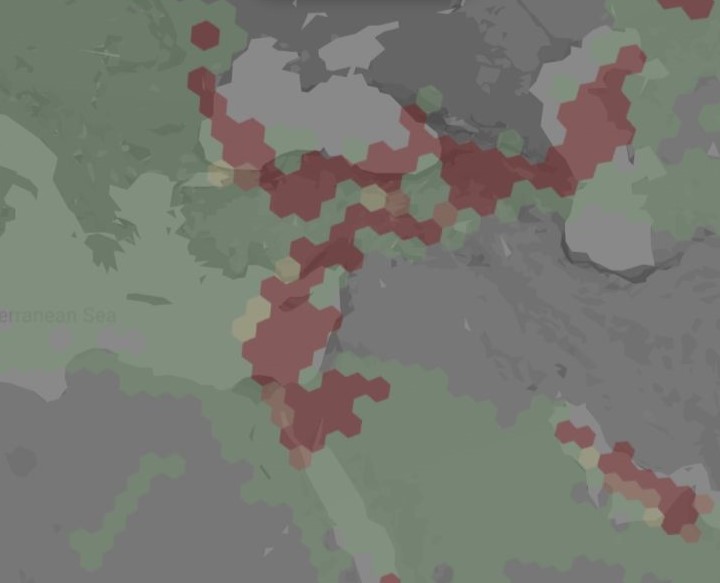
The cause could be GPS signal jamming. Let’s explore why this situation occurs so frequently, particularly in Turkey, Iran, and Ukraine:
GPS (Global Positioning System) relies on weak radio signals sent from satellites orbiting the Earth. These signals are extremely low-power — meaning radio interference generated intentionally or accidentally can easily overwhelm them. GPS jamming broadcasts strong noise in this frequency band, causing receivers to lose their satellite connection.
The result: your vehicle navigation can show you kilometers away from your actual position, flights may be forced to reroute, and port operations can be disrupted. Since many systems — from modern logistics to financial transactions — depend on GPS, this interference is not merely a navigation problem but a critical infrastructure threat.
GPS interference is not a random event. Certain geographies encounter these incidents far more frequently due to geopolitical tensions and military operations.
GPS jamming incidents in Turkey have been documented particularly in the Istanbul Strait and Eastern Anatolia. The Strait is one of the world’s busiest waterways, and location errors there can set the stage for serious maritime accidents. Some analysts associate jamming activity in the region with military operations near the Syrian and Iraqi borders. Turkey’s civil aviation authority (SHGM) has occasionally been forced to issue safety bulletins to pilots regarding GPS reliability.
Iran has effectively demonstrated its use of GPS jamming technology for both defensive and offensive purposes. In 2011, a US unmanned aerial vehicle (the RQ-170 Sentinel) was allegedly brought down onto Iranian soil via a “spoofing signal.” Spoofing is one step beyond jamming: rather than suppressing the signal, it sends a fake GPS signal to direct the receiver to an incorrect location. Iran’s activities around the Persian Gulf periodically affect commercial shipping.
The conflict environment in Ukraine represents one of the areas where GPS interference has most permeated civilian life. Military GPS jammers in conflict zones have come to affect not only drones but also commercial flights, cargo ships, and vessel routes in the Black Sea. The European Union Aviation Safety Agency (EASA) has repeatedly issued special warnings to airlines operating in the region.
GPS does not only answer the question “where am I?” A large portion of modern infrastructure also uses GPS as a time synchronization tool. Banking transactions, stock exchange orders, telecommunications networks, and power grids depend on GPS satellites for nanosecond-precision timestamps. This dependency makes GPS jamming a serious security vulnerability for financial systems and critical infrastructure as well.
A significant portion of solutions developed against GPS jamming is built on artificial intelligence and multi-source data fusion:
Intelligence AI’s Location Intelligence solution is designed precisely to address this need: monitoring the quality and reliability of location data in real time for logistics operators, insurance companies, and security platforms — and reporting inconsistencies through an early-warning mechanism.
It is not possible to completely prevent GPS interference in daily life, but awareness and preparation reduce risks:
GPS jamming will increasingly appear on the agenda in coming years alongside geopolitical tensions and the proliferation of drone warfare. Every sector that relies on location data — transportation, finance, insurance, public safety — must now incorporate this risk into its strategic planning.
Would you like to assess the reliability of your company’s location data infrastructure? Contact us.